

Advanced Platinum P300: Archived LED Fixture Overview
Archive notice, October 2026: This page documents the historical Advanced Platinum Series P300 lighting equipment. It is not a present-day product test, a buying recommendation or confirmation that a listing, model revision or warranty remains available. Some original photographs and the previously configured comparison display are retained for site continuity.
The P300 belongs to the older Advanced Platinum LED panel generation that marketed selectable spectral channels, compact enclosures and multi-band emitters. The original article presented unusually strong performance claims without providing reproducible laboratory measurements or traceable comparative test methods. This revision treats those claims as historical advertising, not independently established results.
The equipment and its design
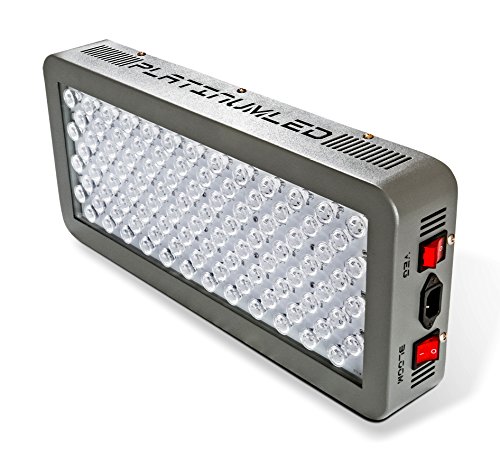
The original P300 material described an integrated fan-cooled rectangular panel, secondary optics and separate selectable operating channels. Those are identifiable design choices rather than evidence of superior light output. Secondary lenses can redirect light, while fans and heat sinks are intended to manage component temperature; none of these features independently establishes optical efficiency.
What the older performance claims do not prove
Statements such as “highest PAR per watt,” fixed HPS-equivalency figures and exceptionally long operating life should not be repeated as verified facts without a defined measurement procedure, model revision and test report. A chip’s nominal wattage is different from the measured power of the complete device, and the number of spectral bands says little by itself about fixture reliability.
The US Department of Energy explains that LED performance and longevity depend on the whole system, including thermal management and electronics. It is therefore incorrect to assume that a model name or chip rating is the same as measured system power. The relevant distinction is between a historical advertising statement and an independently reproduced measurement with disclosed conditions.
Operating life, service and aging
The original article also treated an apparently cool front panel as evidence that little heat is generated. That is misleading: the electronics and rear heat sink can still get hot. Equipment from this generation also depended on cooling fans, mounting hardware and a dedicated driver, all of which age differently from the LEDs.
The P300’s fan-cooled panel and separately selectable channels mean that a functioning LED array is only part of the reliability picture. Cooling, channel switching and driver electronics may age differently, and the dated product description cannot prove that a particular panel remains fully operational. The lighting industry commonly discusses lumen maintenance in terms of retained output, while separate electrical components have their own failure modes. Information on an old sales listing cannot establish the present condition of an individual device.

What a trustworthy technical record would include
For Advanced Platinum Series P300, a credible independent record would identify the precise production revision, input-power measurement, spectral measurement method, optical output, ambient temperature, operating duration and any safety certification. This archive does not supply those test records, and the site’s historical comments should not be misread as a new controlled laboratory evaluation.
The Advanced Platinum P300’s selectable channels and secondary optics help explain why old simple brightness comparisons are difficult to interpret. An output reading depends on which channels were enabled and how the beam was sampled; a model number and a lamp-equivalency claim do not answer those questions. In specialist applications, other measurement systems are appropriate; do not substitute one unit for another without the necessary spectral information.
For background on measurements, see our general light-meter terminology guide. For light-source technology, read LED versus high-pressure sodium lighting. These are educational references, not claims about the performance of this archived model.
Electrical, optical and maintenance safety
Old lighting electronics should not be treated as automatically safe merely because the product originally operated. Damaged insulation, connectors, power supplies or cooling systems are potential hazards. Never operate damaged electrical equipment, bypass safeguards or assume that a fluorescent or ultraviolet component is safe to view directly. Consult a qualified technician or the original model’s official documentation for any servicing.
The appearance of a lamp or its colour is not enough to assess glare and optical hazards. For additional context, read our eye-protection and UV-filtering explainer. Protective eyewear should match the documented hazard rather than a product’s marketing vocabulary.

Archived marketplace comparison
The legacy product table below was created before this revision and is preserved as an existing site element. Listings, prices, configurations and availability may have changed. It should not be treated as a verified current product comparison or a substitute for the manufacturer’s official safety information.
Imported: advanced platinum led
Compare the key features, then see current product details and pricing on Amazon.




As an Amazon Associate, we may earn a small commission from qualifying purchases.
Frequently asked questions
Is the watt figure in the model name its verified electrical draw?
Not necessarily. Historical marketing identifiers and model-family numbers may reflect nominal LED chip ratings or a comparative label rather than power measured at the wall. A reliable claim requires the exact product revision and a measurement record.
Do photographs or a comparison table prove the fixture’s condition today?
No. Photos illustrate an older product and a comparison table can retain historical entries. Neither provides a current inspection, a safety assessment, an up-to-date warranty or evidence of new testing.
Can a claimed 50,000-hour lifetime be treated as a guarantee?
No. Rated LED light-output maintenance is different from the lifespan of electronics, fans and other components. It also does not establish whether an individual piece of older equipment remains serviceable.
Related historical documentation
See the archived Advanced Platinum Series P600 page for another example of the same era of lighting hardware. For technical context from an independent source, consult the US Department of Energy’s explanation of full-fixture efficacy. Comparable, verified data matters more than broad equivalency claims.
Editorial integrity statement: The original article may have described personal use or manufacturer claims. This revised profile does not claim recent first-hand testing of Advanced Platinum Series P300, independent measurement of its output, or confirmation of a current retailer offer. Its original URL has been retained.


