Best Light Meter for Indoor Gardens
It is easy to judge an indoor room by how bright it looks. Measuring its light is more useful. A handheld light meter provides a repeatable number instead of a guess, whether you are checking a windowsill, comparing household lamps, or evaluating lighting equipment for an indoor plant display.
Not all meters answer the same question. A lux meter measures illuminance—the brightness weighted for human vision. A PAR or quantum meter reports the photons in a plant-relevant wavelength range, commonly expressed as photosynthetic photon flux density (PPFD). A large maximum range or colorful display does not make one device interchangeable with the other.
This guide compares four meters already featured on eStageCraft: two lux meters and two PAR-focused instruments. Each section covers what the device measures, its useful controls, practical trade-offs, and the questions to check before purchasing. The comparison is based on available product documentation and published specifications; we have not independently laboratory-tested these four instruments.
Lux vs. PAR: the measurement matters more than the meter
Lux (lx) measures illuminance in lumens per square metre and is based on the sensitivity of the human eye. Foot-candles (fc) describe the same type of measurement in different units; 1 fc is approximately 10.76 lux. These readings help compare general brightness, but their relationship to plant-relevant photons changes with the light source and spectrum.
PAR refers to photosynthetically active radiation, conventionally wavelengths from 400 to 700 nanometres. PPFD describes how many photons within that region reach a square metre in one second and is reported in μmol/m²/s. Some specialized products also measure ultraviolet A or separate colour components; those are additional functions, not the same thing as standard PPFD.
A digital lux meter is often sufficient for ordinary room-lighting checks. A genuine quantum sensor is the more appropriate instrument when a project specifically calls for a plant-light photon measurement. Avoid using one fixed lux-to-PPFD conversion across different lamp types: spectral differences can make the shortcut misleading. The Iowa State University Extension overview explains these measurement differences in more detail.
Four indoor-gardening light meters compared

The existing AzlinkPRO table below brings the four models together. Treat listed functions as model or seller specifications rather than promises of current stock, price, or independent accuracy.
Imported: best light meter
Compare the key features, then see current product details and pricing on Amazon.


As an Amazon Associate, we may earn a small commission from qualifying purchases.
1. MT-912 Mini Digital Lux Meter — convenient everyday brightness readings
Lux Meter - MT-912
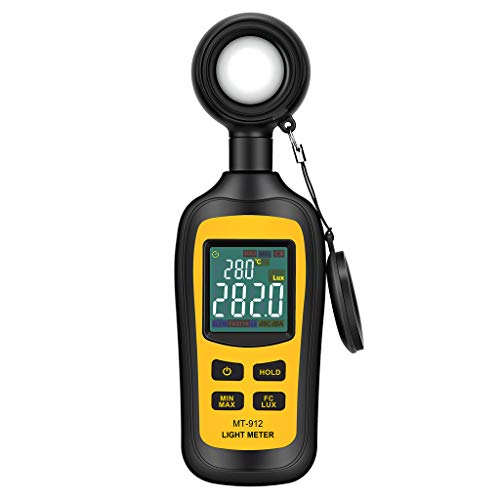
- Measures luminosity from 0 to 200,000 Lux and ambient temperature
- High accuracy of ±3% rdg ± 8 dgts (10,000 Lux)
- 4 digital color LCD screen, MIN/Max readings, data hold, auto power off, and low battery indication
- Wide range of application, use lux light meter for set design, factory, office or home use
- lightweight and compact, 2 years long period warranty
As an Amazon Associate, we may earn a small commission from qualifying purchases.
What it measures. The MT-912 is a compact illuminance meter with a stated range of 0–200,000 lux (up to 20,000 foot-candles). It also displays ambient temperature. These are measurements of environmental conditions, not a direct count of photosynthetic photons.
How it works. Its light-sensitive diode converts incident light into an illuminance reading. The colour LCD shows the result, while a data-hold function lets you freeze a number long enough to record it. Minimum and maximum tracking can be useful when you want to see whether displayed values are changing between observations. Product documentation also lists an automatic shutoff and low-battery indication.
Strengths. The uncomplicated controls and combined light/temperature display make the MT-912 practical for household lighting comparisons, workspace checks, and non-specialist indoor-garden monitoring. A broad measurement range provides flexibility without requiring a separate instrument for ordinary room lighting.
Limitations to know. A lux meter is calibrated around human-visible brightness. It does not provide PPFD, ultraviolet measurements, or a breakdown of the light spectrum. The advertised accuracy also depends on the range and calibration of the specific unit; a specification is not proof that an individual meter has been independently calibrated.
Our assessment: A sensible choice when the question is “How bright is this location?” rather than “What is the photon flux of this light source?” Check the exact seller’s model and included accessories because MT-912 branding and bundles can vary.
Reference: MT-912 model specifications.
2. AH-Quantuv PAR Meter — photon measurement with extra spectral views
AH-Quantuv PAR Meter for Grow Lights

- Measure PAR and UVA Light Accurately. Measure PAR (400–750nm) and UVA (320–400nm) irradiance intensity to understand how your grow lights actually perform. The PAR sensor IC is manufactured by a well-known Japanese semiconductor company, delivering reliable and consistent readings for grow lighting analysis.
- See the PAR Breakdown of Blue, Green, and Red. Unlike most PAR meters that only show a single value, AH-Quantuv displays the PAR contribution of Blue, Green, and Red separately. This helps growers better understand the spectrum of their grow lights and optimize lighting for different plant growth stages.
- Understand How Spectrum Affects Plant Growth. Plants typically require more blue light during the seedling and vegetative stages, while higher red light supports flowering and fruiting. Viewing the spectrum breakdown helps growers adjust lighting to promote healthier plant development.
- PAR Recording Function for Light Distribution Mapping. The built-in recording function allows you to log up to 100 PAR measurements, making it easier to evaluate the light distribution across your grow area and identify hotspots or low-light zones.
- Multiple Display Modes & Easy Operation. Switch between screens to view PAR values, UVA irradiance intensity, RGB PAR breakdown, and historical records. The HOLD function allows stable readings for easy observation. Simple interface design makes operation straightforward.
- Certified Quality. CE certified for reliable performance and safety.
As an Amazon Associate, we may earn a small commission from qualifying purchases.
What it measures. The AH-Quantuv is a PAR/PPFD-oriented handheld meter that also provides a UVA readout and separate blue, green, and red light components. The manufacturer’s product description identifies UVA coverage in the 320–400 nm region and an extended visible-light measurement presentation through 750 nm. Standard PAR is conventionally defined as 400–700 nm, so check the device’s documentation to interpret each displayed mode correctly.
How it works. Rather than reporting a lux figure alone, the device provides a photon-related measurement on a dedicated display. Its additional colour-component screens help distinguish light sources that might produce a similar overall result while having a different mix of visible wavelengths. A hold function can freeze readings, and the manufacturer advertises history/recording features for up to 100 measurements.
Strengths. Multiple clearly separated measurement modes give this model more information than a basic lux meter. Its recorded observations can be useful for consistent technical comparisons and documentation. The battery-powered handheld format does not require a permanently installed sensor.
Limitations to know. Separate red, green, and blue figures are not the same as a laboratory spectrometer’s complete spectral-power graph. UVA is not included in the traditional 400–700 nm PAR definition, and the headline measurement range should not be confused with a claim that all displayed values represent the same quantity. Confirm calibration documentation, weather resistance, and the precise meaning of each screen before relying on it for formal research.
Our assessment: The most feature-rich of the four for someone who specifically needs a PAR-related measurement and more detail about the source’s visible-light components. Those extra measurements are unnecessary for a simple room-brightness check.
Reference: AquaHorti AH-Quantuv product documentation.
3. Hydrofarm LGBQM Quantum PAR Meter — dedicated sensor with legacy data logging
Hydrofarm LGBQM Quantum PAR Meter Micromol Sensor

- Data logging capability using standard mini-USB cable and proprietary data logging software available at Hydrofarm
- Low power consumption with built-in low Battery power Indication
- Constant linear response curve (as opposed to other meters Gaussian response) yields higher accuracy independent of wavelength - perfect for measuring LED light output
- No assembly required
- Logging software compatible with Windows XP, 7 & 10 only
As an Amazon Associate, we may earn a small commission from qualifying purchases.
What it measures. Hydrofarm’s LGBQM is a handheld quantum meter designed to display photosynthetic photon flux density, expressed as μmol/m²/s, across the conventional 400–700 nm PAR region. That is a different measurement from the lux and foot-candle numbers shown by basic illuminance meters.
How it works. The integrated sensor supplies the live reading on the handheld display. Hydrofarm documents a manual HOLD function for storing individual readings and a separate LOG mode for recording data over time. The meter can transfer logged information to a computer using its mini-USB connection and the associated software.
Strengths. A dedicated PAR sensor and onboard logging make it more specialized than the two lux meters. The manufacturer’s documentation also describes different calibration modes for sunlight and electric lighting, a low-battery indication, and a portable carrying case.
Limitations to know. The LGBQM is an older model, and availability may be limited. Its proprietary download software was documented for older Windows releases; compatibility with current computers has not been confirmed. The original article also stated an incomplete “10,000mol” figure; the meaningful unit for a PPFD reading is μmol/m²/s, not simply “mol.” Verify the instrument’s condition, documentation, and support before considering used stock.
Our assessment: A specialist PAR option with useful record-keeping capabilities, provided the legacy software and support situation fit your needs. A contemporary instrument may be easier to integrate into a current computer workflow.
Source status: The archived manufacturer product-page link could not be verified during this review. Treat model-specific features and historical specifications as unconfirmed unless supported by an original technical record. For an independent explanation of light measurement terminology, consult Purdue Extension’s light-measurement reference.
4. LX821 Digital Lux Meter — broad illuminance range with a separate probe
MeterTo Digital Lux Meter LX821

- [ Multi-Function ] Digital Light illuminance Meter with Built-in thermometer can measure the lighting in an area and also automatically measure the ambient temperature.
- [ High Performance ] 1~200, 000Lux/0.01~20, 000FC
- < 100,000LUX
- ± (5% reading + 10 digit)at>100.000LUX
- [ Dual Display ] 4-bit color LCD display, easy to read the measurement, LUX/FC unit can switch freely select, data retention function, data automatically recorded.
- [ Lightweight & Compact Design One-handed operation ergonomic design,This pocket size design makes it easy to carry, no matter where you are.
- [ Wide Range of Application ] Widely used for light test of public stores, library, museum, lamp factory, photo shooting, stage disposition of light, light intensity measurement engineering,quality control, offices, transportation routes, families,etc.
As an Amazon Associate, we may earn a small commission from qualifying purchases.
What it measures. The LX821 is a digital illuminance meter, generally specified for approximately 1–200,000 lux or 0.01–20,000 foot-candles. That makes it a brightness-measurement tool for rooms, displays, workplaces, and ordinary lighting comparisons—not a dedicated PAR or UVA instrument.
How it works. Listings for this model describe a light-sensitive probe, a digital display, a hold function, maximum/minimum readings, and automatic or manual range selection. The separate sensor can make it easier to read the display while keeping the measuring head in a chosen position. Product listings commonly specify a 9V battery.
Strengths. A broad illuminance range and familiar controls are useful when repeatability matters more than advanced spectral analysis. Lux/foot-candle switching supports users working with either measurement convention. The dedicated probe is also a practical design distinction compared with compact all-in-one meters.
Limitations to know. LX821 listings are sold under several different brand names, and their published accuracy figures do not fully agree. Some describe a ±3% figure under certain conditions while others specify additional digit tolerances and reduced accuracy at higher ranges. Do not present a blanket ±3% accuracy claim as independently established for every version. The instrument does not measure PPFD, and no reliable waterproof rating has been verified.
Our assessment: Worth considering for traditional lux measurements when a separate sensor and familiar hold/range functions are priorities. Confirm the exact model, included calibration information, and current specifications from the supplier rather than relying on a generic listing.
Reference: LX821 manufacturer-style specification listing.
How to choose a light meter for an indoor space
- Start with the unit. Choose lux/foot-candles for everyday illuminance checks; choose a PAR-capable instrument only if the project genuinely requires a photon-related measurement.
- Check the sensor and calibration. A headline maximum range tells you little about measurement uncertainty. Look for a clear accuracy statement, calibration instructions, and support.
- Consider recording needs. HOLD, minimum/maximum memory, onboard history, and computer export solve different problems. Buy only the functions you expect to use.
- Check model-specific support. Some older meters use dated download software, while widely resold models can have inconsistent published specifications.
- Look at real usability. Screen readability, battery type, probe placement, and protective storage matter when using a handheld measurement tool.
Frequently asked questions
Is a lux meter the same as a PAR meter?
No. Lux weights light according to human vision. A PAR-capable quantum meter reports plant-relevant photon flux density. The instruments measure related but different quantities.
Can I convert lux directly to PPFD?
There is no universally accurate conversion across all light sources. The relationship depends on the lamp’s spectral output and how the sensor responds to it. Avoid comparing dissimilar light sources through a single fixed conversion factor.
Does the highest stated measurement range mean the best accuracy?
No. Range, resolution, repeatability, and accuracy describe separate characteristics. Read the specific tolerance statement and check whether a calibration certificate is included.
Do these four meters log measurements automatically?
Their capabilities differ. The MT-912 and LX821 offer convenient hold or minimum/maximum features; the AH-Quantuv advertises stored records; and the older Hydrofarm LGBQM supports a logging workflow with legacy PC software. The presence of a memory feature does not necessarily mean automatic computer export.
Are the four products independently tested by eStageCraft?
No controlled side-by-side accuracy tests were performed for this update. The descriptions reflect available manufacturer and supplier specifications. They should be treated as a researched overview rather than first-hand laboratory performance claims.
Light is only one kind of measurement to understand. Our pH pen calibration and care guide covers another type of handheld instrument, including why calibration and sensor maintenance matter.
Bright lighting can also raise questions about eye comfort and appropriate protection. Our indoor lighting eye-protection guide explains the difference between glare reduction, UV filtering and impact-rated eyewear.
For context on why older lighting product claims cannot be validated by their model names alone, see the historical LED lighting equipment archive and our LED versus HPS technology reference. Both distinguish a measured system property from a marketing-era label.
Final thoughts
There is no single best light meter for every indoor setting. The MT-912 and LX821 concentrate on illuminance in lux or foot-candles, with different physical designs and controls. The AH-Quantuv offers a broader collection of PAR-related and colour-component measurements, while the Hydrofarm LGBQM is a traditional quantum meter with an older data-logging workflow.
Choose the instrument by the measurement you actually need, not a broad promise of being the most precise or the most popular. Current pricing and stock change, so check the individual product cards and confirm specifications with the seller. For more background on the measurement terminology, see Purdue Extension’s explanation of light measurement.
Editorial note: This article was refreshed in October 2026 to reflect the four current AzlinkPRO showcases and updated specification references. Product specifications may vary by seller or revision. Affiliate links may earn a commission without increasing the purchase price.